
I have been painting for as long as I can remember.
I grew up in Toronto, but some of my strongest childhood memories belong to its ravines, the places where the city seemed to fall away and another world appeared underneath it. I spent enormous amounts of time drawing, painting, making things and exploring those spaces. Looking back, I can see the beginnings of two lifelong preoccupations: art and the natural world.
My study of art and art history gave me a larger language for understanding what artists do: how we see, interpret and reinvent the world around us. Painting became my primary language, but my practice has never remained neatly within its boundaries. Over the years I have worked with watercolour, acrylic, collage, photography, sound, music, found and constructed materials, installation and, increasingly, the living environment itself.
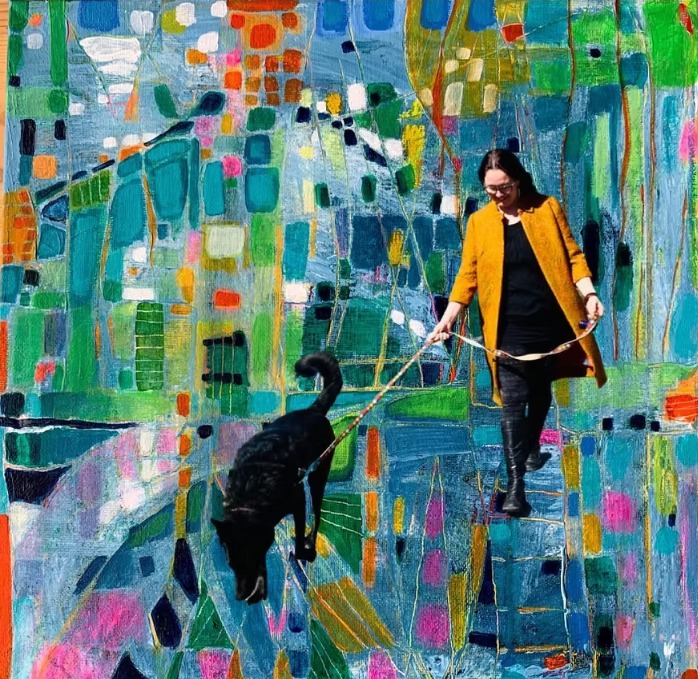
For many years I described my painting process as Intracolourism, my own approach to working intuitively within colour, structure and spontaneous visual relationships. Squares, cubes and boxes became recurring containers for experimentation. I scraped, layered, dismantled and rebuilt painted surfaces, sometimes making my own collage materials and sometimes approaching colour almost musically. When a painting begins to move, I still think of colour much as a musician might think of sound: bending and shifting it until something unexpected emerges.
Music has always been part of that process. So has landscape.
Over time, however, I became less interested in simply depicting nature and increasingly interested in what it means to encounter a living environment.
That question eventually brought me to environmental studies and research-creation. Through my Master of Environmental Studies at York University, my artistic practice expanded into SoilScapes, an ongoing body of work exploring soil, sound, weather, ecological time and the often-unnoticed activity taking place beneath our feet. I began working with microphones, environmental sensors, field recordings, photography, writing and installation alongside paint.
The environment was no longer simply the subject of the artwork. It had become a participant in it.
That realization has changed the way I understand my paintings, too.
Today I think of myself as both a painter and an environmental artist. My paintings still begin with colour, intuition and the physical pleasure of making marks, but they are informed by decades of looking closely at landscape and by a growing awareness that the places surrounding us are never static. Forests grow and disappear. Water moves. Weather alters everything. Soil is alive. Seasons accumulate. Our own memories become entangled with particular places.
I now live and work in the landscape of central Ontario, surrounded by forests, lakes, wetlands, changing skies and the constant movement of non-human life. The distinction I once made between the city and the forest has gradually given way to something more complicated: an interest in the relationships between things and in what becomes perceivable when we slow down enough to notice them.
In some ways, I am still doing what I did as a child, wandering, looking, collecting impressions and coming home to paint.
The tools have simply expanded.